Pawn Promotion: What Happens When a Pawn Reaches the End of the Board?
What happens when a pawn reaches the last row in chess: promotion to a queen, rook, bishop or knight, whether you can have two queens, underpromotion, and the famous Saavedra position. Free lesson.
A pawn is the weakest piece on the board, until it reaches the other side. Then it promotes: it's immediately replaced by a stronger piece. Promotion is why pawn races decide so many endgames.
The rule
When a pawn reaches the last row (row 8 for White, row 1 for Black), it must be exchanged on the same move for a queen, rook, bishop or knight of the same color. The new piece appears on the square where the pawn arrived and works from your next move on.
- You can't keep it as a pawn.
- You can't make a second king.
- Your choice doesn't depend on which pieces were captured: you can promote to a queen even if your first queen is still on the board.
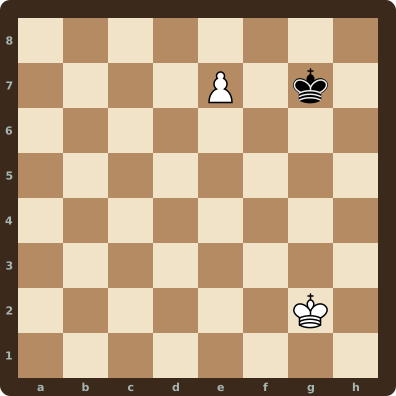
Can you have two queens?
Yes. You can have two, three, even nine queens in theory. Over the board, if you don't have a second queen piece, players use an upside-down rook and say clearly "queen".
Underpromotion: when a queen is the wrong choice
Almost always you promote to a queen, the strongest piece. But sometimes a weaker piece is better. That's called underpromotion:
- To a knight, when the knight gives check or a fork the queen couldn't.
- To a rook or bishop, to avoid stalemate: a queen would leave the opponent with no legal move.
The most famous example is the Saavedra position (1895). White promotes to a queen and it's only a draw, because of a stalemate trick. But promoting to a rook wins! It was found by a priest in Glasgow, a weak amateur, who corrected the experts.
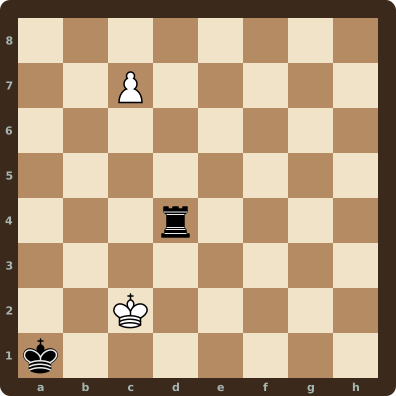
How promotion is written
In notation, the pawn move is followed by the new piece: e8=Q (or simply e8Q). A promotion with a capture looks like dxe8=Q.
Tips for pawn endgames
- Passed pawns must be pushed. A pawn with no enemy pawns in front of it is a future queen.
- Escort your pawn with your king. In king and pawn endings, the king in front of the pawn usually wins, see endgame basics.
- Count the race. Before pushing, count how many moves each pawn needs to promote.
FAQ
What happens when a pawn reaches the other side?
It promotes: you replace it with a queen, rook, bishop or knight of your color. Most players choose a queen.
Can a pawn become a king?
No. A pawn can become a queen, rook, bishop or knight, never a king or stay a pawn.
Can you have more than one queen?
Yes. Promotion doesn't depend on captured pieces, so you can have two or more queens.
Do you have to promote to a queen?
No. You choose any of the four pieces. Promoting to something other than a queen is called underpromotion.
Can a pawn promote on its first move?
No. A pawn starts on its second row and needs at least five moves to reach the last row.