En Passant in Chess: The Rule Explained Simply (With Examples)
What en passant is, exactly when you can capture en passant, the two conditions that must both be true, how it's written in notation, and why the rule exists. With a free interactive lesson.
En passant (French for "in passing") is the strangest move in chess, and the one most beginners have never heard of. It's a special way for a pawn to capture another pawn. It looks illegal the first time you see it, but it's a real rule, and it can decide games.
The rule in one sentence
When a pawn moves two squares from its starting square and lands right beside an enemy pawn, that enemy pawn may capture it as if it had moved only one square, but only on the very next move.
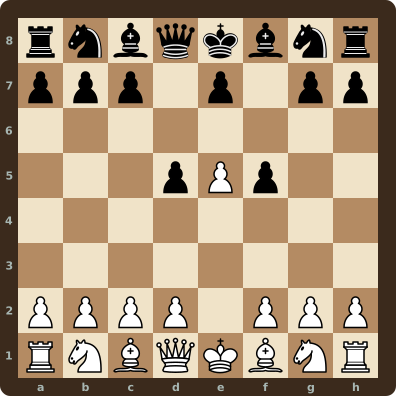
In the diagram, Black has just pushed the f-pawn two squares, from f7 to f5. It landed right next to White's pawn on e5. White may now play exf6: the white pawn moves diagonally to f6 (the square the black pawn skipped over), and the black pawn on f5 is removed from the board.
Try en passant in the interactive lesson
The two conditions
En passant is possible only when both are true:
- The enemy pawn has just moved two squares from its starting square, and it landed directly beside your pawn (on the same row).
- You capture immediately, on your very next move. If you play anything else, the chance is gone for good.
That means your capturing pawn must be on a specific row:
- a white pawn on the 5th row (rank 5) can capture en passant;
- a black pawn on the 4th row (rank 4) can capture en passant.
Where the pawns end up
The capturing pawn moves diagonally to the empty square behind the enemy pawn, exactly where it would be if the enemy pawn had moved one square. The captured pawn disappears from the square it's actually on. It's the only capture in chess where you don't land on the captured piece's square.
How en passant is written
In chess notation it's written like any pawn capture, sometimes with "e.p." at the end: exf6 or exf6 e.p. (the pawn on the e-file captures to f6).
Why does this rule exist?
Pawns originally moved only one square at a time. When the two-square first move was added, centuries ago, it let pawns sneak past enemy pawns that would otherwise have been able to capture them. En passant restores the balance: you can't use the double step to slip past a pawn that could have taken you.
Common mistakes
- Waiting a move. En passant must be played immediately or never.
- Capturing a pawn that moved one square. Only a two-square move allows en passant.
- Trying it with a piece. Only a pawn can capture en passant, and only a pawn can be captured this way.
- Forgetting it exists. Many online games are lost because a player didn't see that their opponent could capture en passant.
FAQ
Is en passant mandatory?
No. Like any capture, it's your choice, unless it is your only legal move. You just have to decide immediately.
Can you capture en passant later in the game?
No. Only on the move right after the enemy pawn's two-square advance.
Can a pawn capture a piece en passant?
No. En passant is only pawn takes pawn.
Can you en passant to get out of check?
Yes, if capturing en passant removes the checking pawn or blocks the check, it's a legal way out of check.
Why is it called en passant?
It's French for "in passing": you capture the pawn as it passes by.