Chess Piece Values: How Many Points Is Each Piece Worth?
The value of every chess piece in points (pawn 1, knight 3, bishop 3, rook 5, queen 9), why the king has no value, how to use the numbers to decide trades, and when the numbers lie.
Before you trade pieces, you need to know what they are worth. Chess players use a simple point system to compare pieces. It isn't part of the rules (nobody counts points to decide the winner), but it is the fastest way to know whether a trade is good for you.
The point value of each piece
- Pawn: 1. The basic unit. Weak alone, but it can become a queen.
- Knight: 3. Jumps over pieces, strong in closed positions and near the center.
- Bishop: 3. Long-range, strong in open positions. Many players value it a little more than a knight, about 3¼.
- Rook: 5. Controls whole rows and columns, and becomes very strong once the board opens up.
- Queen: 9. A rook and a bishop combined, and the most powerful piece.
- King: priceless. If it's checkmated, the game is over, so it can never be traded. In the endgame, though, it becomes a strong fighting piece, worth about 4 points of activity.
How to use the numbers: count before you trade
Before every capture or trade, add up what you give and what you get.
- Your knight (3) for their bishop (3): an even trade.
- Your bishop (3) for their rook (5): you win 2 points. This is called winning the exchange.
- Your rook (5) for their knight (3): you lose 2 points, a bad trade unless you get something big back.
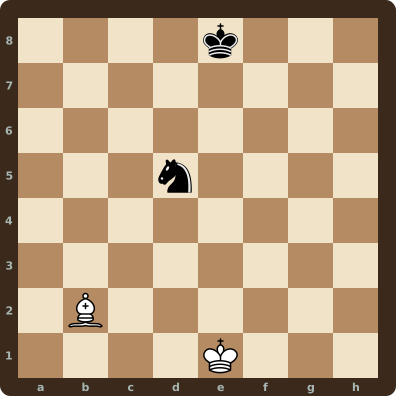
Combinations of pieces
The numbers also compare groups of pieces:
- Two minor pieces (6) are usually better than a rook and a pawn (6) in the middlegame, because pieces work together.
- A rook and two pawns (7) are roughly equal to two minor pieces.
- Two rooks (10) are a little stronger than a queen (9).
- The bishop pair: two bishops together are worth about half a pawn more than bishop and knight, because they cover both colors.
When the numbers lie
Points are a guide, not the truth. A piece is worth what it can do in the position:
- A knight in the center is often stronger than a bishop blocked by its own pawns.
- A pawn about to promote can be worth more than a rook.
- Checkmate beats any material. Giving up your queen is fine if it forces mate, see Légal's trap and the famous queen sacrifices.
- Activity matters. A rook on an open file can be worth far more than a rook stuck in the corner.
FAQ
What is the most powerful piece in chess?
The queen, worth 9 points. She moves like a rook and a bishop combined.
Is a bishop worth more than a knight?
They are both worth about 3 points. Bishops tend to be slightly better in open positions, and knights in closed positions with many pawns.
How many points is the king worth?
The king has no point value because it can't be traded: losing it means losing the game. In the endgame it fights like a piece worth about 4 points.
What does "winning the exchange" mean?
Trading a bishop or knight (3 points) for a rook (5 points), winning 2 points of material.
Are two rooks better than a queen?
Usually slightly: two rooks (10 points) against a queen (9), although a queen is very strong when the opponent's king is exposed.