Draw in Chess: All 6 Ways a Game Can End in a Draw
Every way a chess game can be drawn: stalemate, threefold repetition, the 50-move rule, insufficient material, agreement and timeout against a lone king. Clear rules with examples, from the official FIDE laws.
Not every chess game ends with checkmate. About a third of games between strong players end in a draw: nobody wins, and each player gets half a point. Here are all the ways it can happen, from the official FIDE Laws of Chess.
1. Stalemate
It's your turn, your king is not in check, but you have no legal move. The game is immediately a draw, even if your opponent has a huge material advantage.
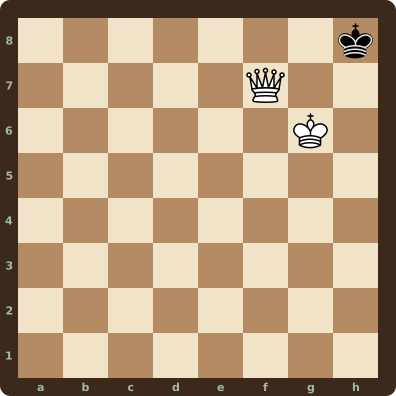
Stalemate is the classic beginner's heartbreak: you're a queen up and accidentally take away your opponent's last move. Always check that your opponent still has a move. See stalemate vs checkmate.
2. Threefold repetition
If the same position appears three times, with the same player to move and the same possibilities (castling and en passant rights), a player can claim a draw. The repetitions don't need to be in a row.
The most common case is perpetual check: one side keeps giving check and the other king can never escape, so the position repeats again and again.
3. The 50-move rule
If 50 moves in a row (by each player) have been played without any capture and without any pawn move, a player can claim a draw. It stops endless games where one side can't make progress.
4. Insufficient material
If neither side has enough pieces to checkmate, the game is a draw straight away. The main cases:
- King against king.
- King and bishop against king.
- King and knight against king.
- King and bishop against king and bishop, with both bishops on squares of the same color.
A king and two knights against a lone king can't force mate either, but a mate is still possible if the defender blunders, so the game goes on.
5. Draw by agreement
Players can simply agree to a draw at any moment. You offer a draw after making your move; your opponent accepts or declines by playing on. Some tournaments forbid draw offers before a certain move.
6. Running out of time against a lone king
If your clock runs out, you normally lose. But if your opponent has no possible way to checkmate you (for example, they only have a king left), the game is a draw instead.
A bonus: the dead position
Under FIDE rules, the game is also drawn when no sequence of legal moves can lead to checkmate, for example when the pawns are completely locked and no piece can break through.
FAQ
What are the ways to draw in chess?
Stalemate, threefold repetition, the 50-move rule, insufficient material, agreement between the players, and a dead position. Running out of time is also a draw if the opponent can't possibly checkmate.
Is stalemate a win or a draw?
A draw. The player who stalemated the opponent doesn't win, even with a huge material advantage.
Does threefold repetition have to be in a row?
No. The same position just has to appear three times in the game, with the same player to move and the same rights.
Can you checkmate with a king and two knights?
Not by force. The defender can always avoid mate, so the game usually ends in a draw.
How many points is a draw worth?
Half a point to each player.