How to Win at Chess: 9 Simple Rules That Actually Work
How to win at chess as a beginner: a strong opening, safe moves, spotting free pieces, simple tactics, trading when ahead and finishing with checkmate. Nine rules with examples.
Nobody wins every game, not even world champions. But at beginner and club level, games are decided by a few simple things, and the player who follows them wins far more often. Here are nine rules, in the order they matter.
1. Look at your opponent's move first
Before you think about your own plan, ask: what does my opponent want? Every move has a purpose: an attack, a threat, a trap. Most lost games start with a threat nobody looked at.
2. Don't give pieces away
Before each move, do a blunder check: is the piece I'm moving safe on its new square? Did my move leave another piece unprotected? Just this habit wins more games than any opening.
3. Take free pieces
The flip side of rule 2: when your opponent leaves a piece undefended, take it. Count attackers and defenders on that square. If you have more attackers, the capture wins material. Know the piece values so you trade up, not down.
4. Win the opening with three principles
- Control the centre with your e- and d-pawns.
- Develop your knights and bishops before moving the same piece twice.
- Castle early to keep your king safe.
You don't need to memorise long lines. Follow these three ideas and you'll get a good position in almost every game. See chess openings for beginners.
5. Learn the three tactics that win most games
The fork, the pin and the skewer win material in game after game. Once you know their patterns you start seeing them everywhere, for both sides. They're explained with examples in fork, pin and skewer.
6. Always look for checks, captures and threats
Before you settle on a quiet move, check every check, every capture and every threat you can make, in that order. Forcing moves leave your opponent less choice, and that's where tactics hide.
7. When you're ahead, trade pieces
A piece up? Exchange the other pieces: every trade makes your extra material count more. A queen against no queen in an endgame wins easily. When you're behind, do the opposite and keep pieces on the board.
8. Know how to finish
Many winning positions end in a draw because the stronger side can't deliver mate. Learn the basic checkmates with the queen and with the rook, and the most common pattern of all, the back-rank mate:
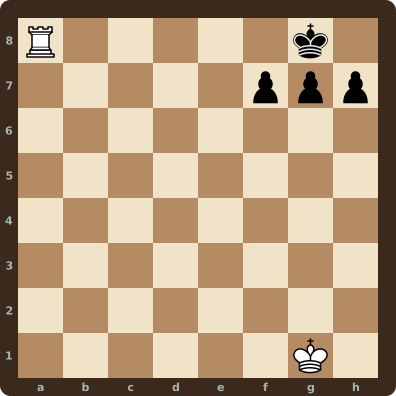
And watch out for stalemate: when your opponent has no legal move and isn't in check, the game is a draw. See how to checkmate.
9. Learn from every game you lose
Every loss shows you a mistake you'll make again unless you study it. Go through your games, find the moment it went wrong, and practise that position until you get it right.
A simple routine to start winning
- Every day: 10 minutes of puzzles.
- A few times a week: a game against a bot or a person at your level, with no rush.
- After each game: a quick review of your biggest mistake.
FAQ
How do you win at chess every time?
Nobody wins every game, but you can win most games against players at your level by not giving pieces away, taking free pieces, following opening principles and learning basic tactics and checkmates.
What is the fastest way to win at chess?
The fastest checkmate is the Fool's Mate in two moves, but it only works if your opponent plays very badly. Against real opponents, winning material with tactics and then trading pieces is the fastest reliable path.
How can a beginner win at chess?
Blunder-check every move, develop your pieces and castle early, look for checks, captures and threats, and practise puzzles daily. These habits alone beat most beginners.
What should I do when I'm winning?
Trade pieces to simplify, keep your king safe, push your passed pawns and avoid stalemate when you go for checkmate.