Fork, Pin and Skewer in Chess: The 3 Tactics That Win Games
The fork, the pin and the skewer explained with clear board examples: how each tactic works, how to spot it in your games, how to defend against it, and free puzzles to practise.
Most games between beginners and club players are not won by deep strategy. They are won by tactics: short sequences that win material by force. Three of them appear in almost every game: the fork, the pin and the skewer. Learn to see these three and you will win pieces you used to miss, and stop losing pieces you used to give away.
The fork: one piece, two targets
A fork is a single piece attacking two (or more) enemy pieces at the same time. Your opponent can only save one of them, so you win the other.
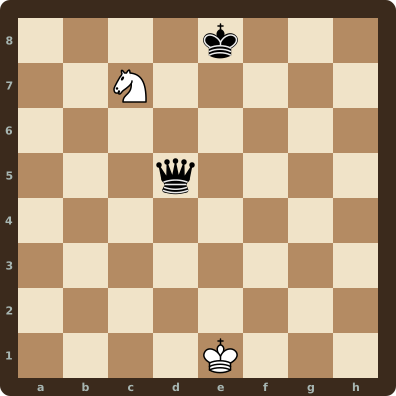
Every piece can fork, even the king and pawns, but the knight is the champion: its L-shaped jump attacks squares that look safe, and it can't be blocked. The strongest forks come with check, because the opponent must answer the check first and has no time to save the second piece.
How to spot a fork: look for two enemy pieces that are a knight's jump apart from the same empty square, or on the same line as one of your pieces' squares. Kings and queens are the best targets.
The pin: a piece that can't move
A pin is an attack on a piece that cannot move without exposing a more valuable piece behind it. Only the long-range pieces pin: the bishop, the rook and the queen.
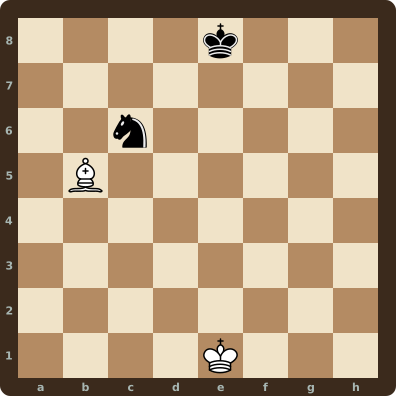
There are two kinds:
- Absolute pin: the piece behind is the king. The pinned piece is not allowed to move at all, by the rules.
- Relative pin: the piece behind is worth more (often the queen). Moving is legal, but it loses material.
How to use a pin: attack the pinned piece again, with a pawn if you can. It can't run away, so you win it.
The skewer: the pin turned around
A skewer is like a pin in reverse: the more valuable piece is in front. When it moves out of the attack, the piece behind it falls.
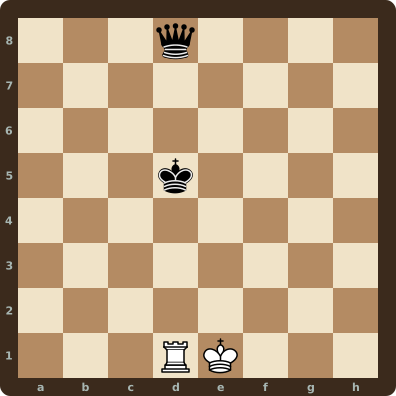
Skewers are very common in endgames, when kings and queens stand on open lines. Before you put your king and queen on the same file, rank or diagonal, check whether an enemy rook, bishop or queen could line them up.
Fork, pin or skewer: the quick test
- One piece attacks two targets: it's a fork.
- Two pieces on one line, the one in front is worth less (it can't move): it's a pin.
- Two pieces on one line, the one in front is worth more (it must move): it's a skewer.
How to defend against all three
- Don't line up valuable pieces. King and queen on the same line invite pins and skewers.
- Watch knight squares near your king and queen. Before each move, ask which squares an enemy knight could jump to.
- Keep pieces protected. A fork only wins material if one of the targets is undefended or worth more than the attacker.
- Break the pin early: move the piece behind out of the line, or block with a cheap piece.
How to get good at tactics fast
Tactics are pattern recognition. The fastest way to learn them is to see the same pattern many times: 10–15 minutes of puzzles a day beats one long session a week. Start with forks, then pins, then skewers, and let the puzzles get harder as your rating goes up.
FAQ
What is a fork in chess?
A fork is one piece attacking two or more enemy pieces at the same time. The opponent can only save one, so the other is lost. Knight forks are the most common.
What is the difference between a pin and a skewer?
In a pin, the piece in front is worth less and can't move without exposing a more valuable piece behind. In a skewer, the piece in front is worth more, so it moves away and the piece behind is captured.
Which pieces can pin?
Only the bishop, the rook and the queen, because a pin needs a long straight or diagonal line.
Is an absolute pin different from a relative pin?
Yes. In an absolute pin the king is behind, so moving the pinned piece is illegal. In a relative pin moving is legal but loses material.
How do I practise tactics?
Solve a few puzzles every day on one theme at a time. Chessizi's puzzles adapt to your rating and explain every mistake.