10 Chess Tactics Every Player Must Know
Master the chess tactics that win games: forks, pins, skewers, discovered attacks, double checks, deflection and more, each with free puzzles to practise.
Tactics are short, forcing sequences that win material or checkmate. At every level below master, most games are decided by tactics. Learn these ten patterns and you'll start seeing them in your own games.
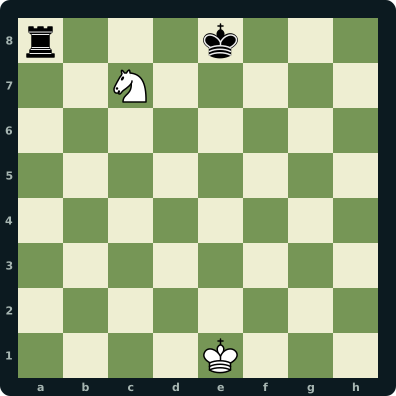
1. The fork
One piece attacks two targets at once, and the opponent can only save one. Knights are famous for forks, but every piece can fork, even a pawn.
2. The pin
A piece can't move without exposing a more valuable piece behind it. If the piece behind is the king, the pin is absolute: moving is illegal. Attack a pinned piece again; it can't run away.
3. The skewer
The reverse of a pin: the more valuable piece is in front. When it moves out of the attack, the piece behind it falls.
4. The discovered attack
Move one piece out of the way and a piece behind it suddenly attacks. The moving piece can make its own threat at the same time, creating two threats in one move.
Solve discovered attack puzzles
5. The double check
A discovered attack where both pieces give check. The king must move, because you can't block or capture two checking pieces at once. It's one of the most powerful moves in chess.
6. Hanging pieces
The simplest tactic of all: a piece left undefended. After every opponent move, ask "what did that move leave unprotected?" and after every one of yours, check the same.
Practise spotting hanging pieces
7. Removing the defender
If a piece is protected only once, capture or chase away its defender and it falls.
8. Deflection
Force a defending piece away from the square or line it guards, often with a sacrifice.
9. The back-rank mate
A rook or queen checks along a back rank where the king is trapped by its own pawns. Always check whether your opponent's back rank is weak, and give your own king an escape square. Read the checkmate guide.
10. The in-between move
Before recapturing automatically, look for a stronger move first, often a check. Players who find in-between moves win a lot of material from players who don't.
How to train tactics
- Solve rated puzzles every day; our coach explains why each wrong move fails.
- Every puzzle you miss comes back for review later, so the pattern sticks. See your review queue.
- Test your speed in Puzzle Rush.
FAQ
What is the most common chess tactic?
The fork and the hanging piece. Together they decide a huge share of beginner and club games.
How many puzzles should I solve a day?
10 to 20 focused puzzles a day is plenty. Accuracy matters more than speed: take your time on each one.
Are tactics or strategy more important?
For players under about 1800, tactics. Strategy matters, but a single tactical mistake usually decides the game first.